Cult status is usually conferred years later and occasionally arrives immediately. The difference tends to involve how closely a film matches its audience's own recent experience.
I first watchedThe Craft—the cult-classic horror film about four teenage outsiders who form a witches’ coven—in a friend’s college dorm room, drinking the kind of shitty red wine only underage students would touch. The film had premiered in 1996, when I was five, but by college, I’d acquired enough insecurities and been female in this world for long enough to appreciate it. Four young female outsiders finding friendship and the power to make their tormentors regret it? I understood the appeal.
The Craftremains a touchstone because it makes being a so-called freak look like an excellent time. The film’s declaration “We are the weirdos, mister” has resonated so much with audiences that some have tattooed it on their bodies. For queer viewers, the girls’ friendship offered a vision of being different without being alone; in the decades since its release, director and co-writer Andrew Fleming has heard many people say that the film helped them come out.
In October,Bazaaris celebrating our obsessions—how they delight us, connect us, and keep us going. Tune in each day for a new story, orgo hereto read them all.
“We saw a lot [of movies] about boys being together and doing these things [at that time], but not that many for women,” says Spanish actor Assumpta Serna, who plays Lirio, the girls’ benevolent witch mentor. “So I think that the idea that four girls could actually protect each other, it was interesting. It was something that connected with young people that were a little bit strange or weird. The rebels.”
While Hollywood has (somewhat) changed, the obsession withThe Crafthasn’t. In 2020,The Craft: Legacyintroduced a new foursome of teenage witches, while this year’s dark comedy horrorForbidden Fruitsdrew inspiration from the original to assemble a coven of shopping-mall employees. Author Mona Awad cites the film as an influence forBunny, her novel about a sinister clique of graduate students; Mollyhall Seeley’s fiction debut,We Hexed the Moon, about four friends whose ritual goes awry, is marketed as “BunnymeetsThe Craft.”
Even Bratz has just releasedthe original quartet of witches in miniature, Catholic school uniforms and all. “They sold out almost immediately,” says Rachel True, who played Rochelle, one of the four young witches. “We don’t even get a doll out of this!”
For the film’s 30th anniversary, I spoke with True and Serna, along with director and co-writer Andrew Fleming and producer Douglas Wick, about how they brought the fantasy to life and why so many of us have yet to get over it.The Craftfollows Sarah (Robin Tunney), a high school girl who has survived a suicide attempt and is looking for a fresh start at a Los Angeles Catholic school. Instead, she becomes the subject of a humiliating sexual rumor when Chris (Skeet Ulrich), a boy she initially likes, claims they slept together after she rebuffs his advances. Nancy (Fairuza Balk), Bonnie (Neve Campbell), and Rochelle (Rachel True), three outcasts already dabbling in witchcraft, recognize Sarah’s supernatural gifts and recruit her as the fourth member needed to complete their circle.
Each has her own reasons for experimenting with magic. Nancy lives with an abusive stepfather, Bonnie keeps her body covered to conceal the severe burn scars across her back, and Rochelle faces a classmate who recoils from her touch and makes racist remarks about her hair. Together, their tentative forays into magic give them a place to belong and a way to fight back.
Thirty years later, the fantasy remains irresistible, and the fury all too familiar. What if you could make the boy who humiliated you fall desperately in love with you? Make the racist classmate who mocked your natural curls lose her blonde hair? Change the body you’ve been taught to hide? For all its conjurings and chants,The Craftunderstood from the jump that being a teenage girl supplied plenty of terrors already. “We never thought that the witchcraft was the horror,” says director and co-writer Andrew Fleming of the film. “Almost every woman I know has dealt with some form of male aggression or sexual predatory behavior,” says True. The spells may require imagination; the reasons for wanting them hardly do.
Producer Douglas Wick developed the project withFlatlinersscreenwriter Peter Filardi before Fleming joined to rewrite and direct it. Though the crew was led by men (“back in the ’90s, almost everything was written by a man,” True says wryly), they brought their own experiences of alienation to the girls’ stories. Wick grew up witnessing the perils of girlhood through his three sisters; Fleming, who is gay, was relentlessly bullied and isolated at a demanding religious boys’ school. “I guess I was sort of channeling my teenage alienation,” Fleming says. His rewrite drew on college acquaintances, including a woman whose burn scars remained hidden beneath her clothes and another he found in her dorm room after she had cut her wrists.
Wick wanted to capture the transformation friendship offered. “I’m isolated, I’m lonely, I’m not understood, and now that I’m feeling community, the community feels powerful,” he says. “That’s what we were trying to express.”
That understanding had its limits. Rochelle was originally written as white, with a storyline about disordered eating that was replaced with one about racism after True was cast. She wished both had remained. “Why couldn’t I be bulimic and dealing with racism?” she asks. “I don’t see my Blackness as a problem, and everyone else had a problem.”
Though she remains glad the film addressed racism, its promotion still subjected her to exclusion. She recalls photographer Greg Gorman noticing that she kept being positioned at the back during the poster shoot, and says she was initially excluded from the publicity junket until Campbell advocated for her inclusion on one leg of it. “That hurt,” she says. The studio was selling a story about outsiders finding their power while denying one of its four leads the visibility—and potential career opportunities—afforded to the others.
Getting the film made had required its own argument about whose stories deserved attention. “Darkness was no problem because horror movies were always a good business,” Wick says. But a movie centered on four young women was apparently a more unsettling proposition. There’s an irony here: a film about girls discovering their power had to justify why anyone would want to watch them wield it. The answer later came at the ticket counter, whereThe Crafttopped the North American box office on its opening weekend and eventually grossed $55.7 million worldwide against a $15 million production budget.
To win over the studio, Fleming filmed the four actresses in costume—a blend of Catholic-school propriety and ’90s grunge—walking toward the camera in slow motion to the music of Portishead, the dark electronic band he had been listening to while writing the script. Suddenly, executives got it: Fleming remembers the response being, essentially, “Oh, that’s what the movie is.”
He had asked costume designer Deborah Everton to imagine young pagans who looked like fans of the Cure or Siouxsie and the Banshees; shortened skirts, spiked necklaces, and chunky lace-up boots turned uniforms meant to make them conform into expressions of who they wanted to be. Together, the clothes, don’t-fuck-with-us swagger, and moody soundtrack made adolescent alienation look like something you’d want in on. “We had a great costume designer on the film, but literally, that’s how we dressed in the ’90s,” True says. “We didn’t know we were making a fashion statement.”
Despite their mentor’s warning that whatever they send out will come back to them threefold, the girls start casting spells with their fourth now in place. Bonnie’s scars heal, Rochelle’s tormentor loses her hair, and Chris becomes besotted with Sarah. “When you’re really in high school, you don’t have the perfect one-liner. You think of the comeback late,” True says. “So to be able to replay those moments, but have the witty one-liner or one-up them with the spell or magic, you get to exercise your high school demons.”
Historical witch hunts were fueled by misogyny that turned ordinary women into objects of suspicion and persecution. Fleming’s research helped him look beyond the sinister associations that history and Hollywood had attached to the practice of magic. “I know people who practice, practicing pagans, who use it to manifest health and happiness,” he says.
To bring that understanding to the film, the filmmakers enlisted Pat Devin, a Wiccan priestess, to advise on rituals and guide the actors. Her involvement also established boundaries: “She was very clear that we should not try to invoke real known gods or goddesses,” Fleming says. At her urging, they used a fictional deity, Manon, rather than turn a figure people worshiped into an instrument of movie terror.
Before filming, True and Balk, already a practicing pagan, separately attended a Beltane, or May Day, celebration with Devin’s coven. True remembers a couple being bound to a maypole with ribbons, part of an education in witchcraft’s sexual dimensions that included some unexpected advice. “[Pat] was like, ‘Oh, if you want to attract a man, you can take your vaginal secretions and rub it on his steering wheel,’” True recalls. “I’ve never done that, for the record.” The cronelike witches she remembered seeing onscreen had hardly prepared her for this connection between magic and desire, which echoed the characters’ dawning awareness of their own sexual power.
For Serna, preparing with Devin revealed a community whose openness helped shape Lirio’s protective presence. Visiting occult shops around Los Angeles, she watched the practitioners at work, borrowing one shopkeeper’s seed-sprinkling gesture for her performance. “I came up with it because I saw someone doing it,” she says. “They were happy. There was an interior peace that I could see within these people. All these people that have this strong spirituality in their lives, they also want to protect others. I think it’s a beautiful concern.”
Devin’s guidance followed her home, too. “She made me buy some candles for my house to protect me,” Serna remembers, placing them, as instructed, in each corner. Lirio offers Sarah protection without demanding obedience in return.
Nancy, meanwhile, wants more than protection. During a nighttime beach ritual filmed near Point Dume in Malibu, she asks to receive Manon’s full power, seeking a transformation that will put her beyond anyone else’s control. For the scene, the crew had set up a circle of gas-fed flames, placing it just beyond the reach of high tide on a park ranger’s advice. But as the actresses began their invocation, Fleming remembers the ocean swelling until a rogue wave swept across the set, extinguishing the flames. Then the power went out. “It kind of rattled everybody,” he says.
True, who had been calling on water, was less rattled than impressed with herself. “I am powerful!” she remembers thinking, laughing as she turns her palms and face toward the sky to reenact the moment.
The film eventually insists on consequences after the girls begin enacting their revenge. Bonnie’s confidence gives way to vanity, Rochelle feels remorse at her classmate’s distress, and Chris becomes possessive and sexually aggressive. Nancy’s increasingly violent behavior fractures the group, and when Sarah tries to withdraw, the friends who offered her protection turn their knowledge of her vulnerabilities against her. Sarah survives; Nancy ends up confined to a psychiatric institution. This is the part that hasn’t aged well. It’s difficult to see a girl whose rage began with real abuse end up restrained and dismissed as crazy. Watching it today, with a man found liable for sexual abuse in the White House, makes the contrast harder to stomach.
But the ending isn’t why I and countless others return toThe Craft. We come back for the image of four girls walking together as though the hallway belongs to them, for the thrill of discovering that the things that made them outsiders might also make them powerful. They don’t have to win over the popular girls or become anyone’s idea of normal. They’re still weirdos, just weirdos you might want to stop messing with.
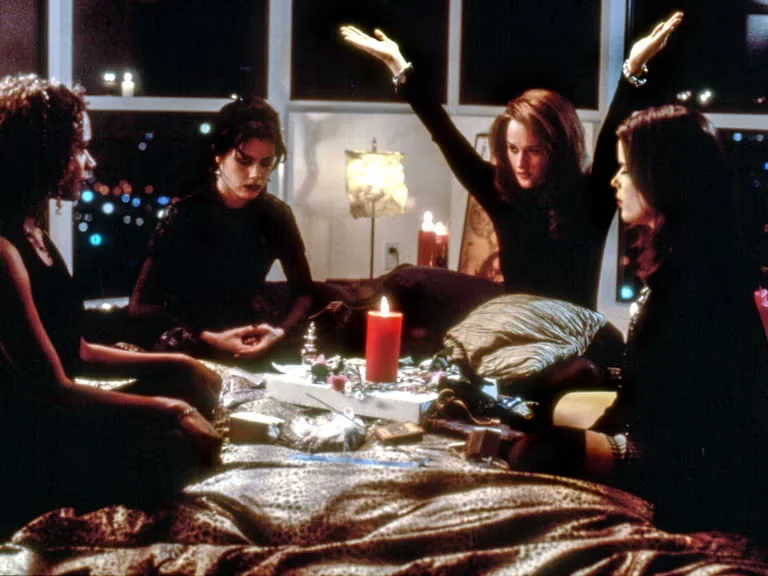
There’s a scene earlier in the film where the girls gather around Rochelle at a sleepover, fingers tucked beneath her body, repeating “Light as a feather, stiff as a board.” For anyone who spent childhood evenings on bedroom floors, giggling through the chant while secretly hoping it might work, the scene delivers on a delicious possibility. Rochelle rises beneath her friends’ fingertips and floats toward the ceiling. “You’ve gotta try it!” she tells them. Before the betrayals and punishments, there is a girl discovering what she can do with her friends beside her, and wanting them to experience it too. Maybe there’s no spell that can actually make you comfortable in your own skin. But if you find the right people, you don’t need one.
EXPLORE MORE OF BAZAAR’S OBSESSIONS MONTH
Readers Also Read
Why Is Everyone Romanticizing the 2010s?
The Lasting Style Legacy ofMarie Antoinette
All the Best Celebrity Halloween Costumes of 2026
Justin & Hailey Bieber Went All Out for Halloween
31 Things We’re Obsessed With Right Now
Ralph Lauren’s Polofest Was a Fashion Dream
Inside the Hirshhorn Museum’s New Sculpture Garden
Gloria Estefan Answers the Bazaar Questionnaire
The Art of Dressing for Fall in the City
Beyoncé Poses in a Rare Three-Generation Photo
Gigi Hadid’s Preppy Fit Is Full of Fall Statements
The Royals Share a Halloween Throwback of Louis